Tuesday, September 20, 2005

Simon Wiesenthal Changed My Life

It was this story oft told by Simon Wiesenthal, and as shared on Jewlicious, that truly changed my life:

Wiesenthal spoke often of a Sabbath dinner he had spent at the home of another survivor of Mauthausen, who had become a wealthy jeweler. The man speculated that Wiesenthal could have become a millionaire if he had gone back to architecture instead of hunting Nazis.

“When we come to the other world,” Wiesenthal said he responded, “and meet the millions of Jews who died in thecamps, and they ask us, ‘What have you done?’ there will be many answers.

“You will tell them, ‘I became a jeweler.’

“Another will say, ‘I smuggled coffee and American cigarettes.’

“Another will say, ‘I built houses.’

“But I will say, ‘I didn’t forget you.’.”

This story is what sparked a lifelong interest in the Jewish people. It is what inspired my thesis in college, entitled "Ha-Shoah". It is what caused me eventually to identify so closely and bond so tightly with the Jewish destiny that I had no other choice but to become a Jew.

So while Simon Wiesenthal never knew me or spoke to me, he changed my life. He inspired me with a lifelong devotion to a people of whom I was not a part but to whom I eventually joined my destiny.

My heart truly spoke the words that Ruth spoke so long before me, "Your people shall be my people, and your God, my God."

Becoming a Jew meant leaving behind an old life, gaining new friends and family, grieving for old friends and family who couldn't accept a choice I was compelled to make. It meant hitching my wagon to a destiny that continues to evolve - one which isn't necessarily "safe" or "privileged" but one which provides more satisfaction and happiness than I ever could have imagined.When people ask me what inspired me to convert to Judaism, I never mention Simon Wiesenthal. Instead I mumble things about "faith" and "how I believe" and "the one-ness of G-d"...but I never mention what really drew me to even consider it. I never mention the man who chose never to forget his people...and inspired me to never forget those who would become MY people either.

Maybe I should mention this.

Who changed YOUR life?

(Cross-posted at JewView and Matzah and Marinara)

I-Connect

My son started working on the I-Connect program in Sunday School yesterday. It's designed to teach the kids about Israel and to encourage them to feel more connected to the land and the people.

I asked Evan if he had enjoyed the program.

"Yes, Mom," he said in that way that older children have of indicating that you're interrupting their deepest thoughts and most involved activity.

"Oh good!" I said. "Do you want to go to Israel now?"

Now, don't forget, Evan has always said that he wants to go visit Israel because he says that's where his "people" are.

"I don't think so," he said.

"Oh???" I was shocked.

"Those other people that live there? The different ones? They're scary."

My son has finally learned about Palenstinians.

I found that incredibly sad in a way....his innocence, his childhood, his ability to see the good in everyone, to see past a skin color or a religious label...all gone.

And on top of that, now he's afraid of Israel and going there.

"Well, Evan that's just a few radical people. Not all Arabs or Palestinians are like that. You have to remember that," I assured him.

He looked at me skeptically. "I am still not going. They'll KILL me!"

Very interesting development. On one hand, I don't want him to be afraid of the world or his place in it. On the other, I certainly want him to be aware, as a Jew, of the potential dangers out there. I also want him as a human being to try to overcome those dangers while still being very comfortable with himself.

Very interesting.

Whatever happened to those "tough" questions about puberty?????

(cross posted at Matzah and Marinara)

Monday, September 19, 2005

Perception

Despite the fact that I usually do not discuss Jewish topics around some of my relatives, I am still perceived as being "so religious", and my actions are sometimes mistakenly interpreted to be commentary on their lives.

Many times, I am between a rock and hard place since some of my family members are incredibly uncomfortable about any exterior displays of Jewishness. They subscribe to Yehuda Leib Gordon's philosophy, "Be a Jew inside your home and a man on the street." Judaism to them is something that should only be observed internally. They become uneasy around all things Jewish, sometimes even hesitating to put up a mezuzah on their doorpost since this would only call attention to the fact that their house is a Jewish home.

I do not utter judgmental comments or give disapproving glances at what others do. With less-observant relatives, I strive to build bridges and be as accommodating and considerate as possible while not compromising my beliefs. Sometimes, however, it feels like my efforts are an exercise in futility. Although Gordon's philosophy is the antithesis of how I live my life, I continue to struggle to see things from their point of view and remind myself that we are all Jews and one family.

--
(Cross Posted on A Simple Jew)

Friday, September 16, 2005

Unetaneh Tokef

As I mentioned in the audio post below during this time of year it is common practice for Jews to become more reflective about themselves and their place in the world around them. I think that it is a very important task and one that is necessary if you are going to continue to grow as a person.

There is a prayer called "Unetaneh Tokef" that is said on Rosh Hashanah that always catches me as I am sure that it does many others. There are a couple of different stories that I have heard about its origins. Here are links to two of them. As you can see they are intense.

But I want to focus on a couple of things that we say in the prayer itself that I think are of interest.
On Rosh Hashanah it is written and Yom Kippur it is sealed
How many shall pass on and how many shall come to be;
who shall live and who shall die;
who shall see ripe old age and who shall not;
who shall perish by fire and who by water;
who by sword and who by beast;
who by hunger and who by thirst;
and
Repentance, Prayer, and Charity temper judgment's severe decree.
Those are some pretty heavy concepts, so I am going to post about the first section and then then comment on the second.

As a young boy whenever we said Unetaneh Tokef I always pictured a very old man at a desk. There was a book a quill and some ink that the man used to write in the book. I remember thinking that it would be very hard for the man to hear me and that his head must really hurt because all these people were trying to speak to him.

I can also remember wondering if he really knew about all the things that I had done. Did he know that I had managed to sneak candy into my room even though my mom had said no. Did he know that sometimes at night when I was supposed to be in bed I would sneak into the hallway and listen to whatever show my parents were watching.

Or was he aware that Teddy Holtz had found a magazine with pictures of nude girls and we were looking at it. As an adult I laugh at that memory. We were about 8 years-old and we thought that the people in the magazine were really stupid. Because who would sit naked on the back of a motorcycle. You would get really cold and if you fell off you'd get really scraped up.

I can remember the superstitions of the older people, the whispers and gestures they made to ward off the evil eye, the hands they clamped over our ears during certain times.

All these memories jumble together because I took Unetaneh Tokef literally, even though I had some doubts about the power of G-d in the end I was afraid that he really did know everything and that something bad could happen. In short, it was a very black and white interpretation.

Now I look at Unetaneh Tokef and I think of it in broader terms and I understand that section to be more comment than literal because the reality is that I cannot make the decision of who will die and who will live for myself or for anyone others. Those decisions are out of my hands and it is important for us as people to be aware that what we do, the choices we make impact others.

This leads into the second part where it says:
Repentance, Prayer, and Charity temper judgment's severe decree.
Please note that I am using English translations so that more people can read this, I don't usually translate Tzedakah as Charity. It is usually more like Righteousness but there is a lot more to that discussion than this so for simplicities sake we'll use charity.

In the past when I have engaged in learning about this line some people have discussed these as three separate concepts and it bothers me to hear Tshuvah, Tefilah and Tzedakah handled as separate units relative to this conversation. The reason being is that Unetaneh Tokef is a personal discussion with G-d in which we praise and tremble. It is a time to consider our own actions and I find it troubling to suggest that one could merit another year of life simply based upon tefilah/prayer.

Because if we are saying that we have done wrong and that we wish to engage in tshuvah, repentance then I think that it must include the act of tshuvah. I find fault with the idea that one could ignore tshuvah and simply daven. There is a lack of responsibility and personal accountability that irks me.

So I don't see how you can separate prayer from repentance. They are two pieces that work together. Tzedakah is a different story. One can give without repenting or prayer. You could easily make a donation to charity xyz without the other two components.

On a personal note I follow the Rambam's example of how to give.

That is it for now, perhaps I'll share more thoughts later.

Thursday, September 15, 2005

Phenomenal Posts

I know that it has been slow around here, but that is only because there are some incredible posts being worked on.

Monday, September 12, 2005

Our Synagogues are Burning

I was less than happy when I read this article but not all that surprised.
"Palestinians rushed into the abandoned settlements, firing guns, singing and in some cases setting fire to abandoned synagogues.

Abbas said the joy of the Palestinians was understandable after years under Israeli rule. "They have to express their feelings," said Abbas."

Some of you will call me nasty names for presenting this as being symptomatic of a larger problem, but I question the civility of people who express their joy with arson, who talk about engaging in peace talks by promising more violence and who dance in joyous celebration at the mention of indiscriminate murder.

The hard work is coming. The time of trying to gauge whether there is a real partner on the other side of the table or someone who is looking for a Trojan Horse.

On the upside of things I was pleased to read this in the same article.

"After Israeli forces closed the Kissufim gate behind them, an IDF spokesman challenged Palestinian officials.

"From this point on, the full responsibility for events occurring in the Gaza Strip and for thwarting terror attacks against Israeli targets will be in the hands of the Palestinian Authority and its apparatuses," a statement said.

Gaza commander Brig. Gen. Aviv Kochavi expressed similar sentiments.

"For all that takes place in (the) Gaza strip lays on the Palestinians," he said. "The responsibility for the security of the Israelis is all ours.

"The very same soldiers that have left the (Kissufim) gate are those who are deploying now along the new line," Kochavi continued. "They are alert and they are ready to fulfill any mission and to face any challenge."

Now the full weight of that responsibility will be felt and we shall see what kind of hand the other side holds. Still I need to mention that I am somewhat saddened to have to use terms like side in this manner because it reminds me that there is still so much work to do to bring in the humanity of the situation for everyone.

Monday, September 05, 2005

Secret Lives

One of the most interesting aspects of the blogosphere is the opportunity to learn more about people that you might not otherwise encounter. From a Jewish perspective I find the look inside some of the more frum among us to be very interesting.

Some of the blogs that have caught eye for a moment or two include A Hasid and a Heretic and Hasidic Rebel. There are others that interest me.

I wonder how many people are truly satisfied and how many have serious doubts that are strong enough to make them stray. It is not always so easy to attend to certain paths.

Wednesday, August 31, 2005

Hasbara Needed Now More than Ever

Elder of Ziyon has a nice piece today that discusses the need for better hasbara. It is worth a read.

Tuesday, August 30, 2005

Strength in Adversity- Questioning Ourselves and Reliance

Our history is replete with examples of our people overcoming adversity. One of the things that I love about our tradition is not just the fact that we have always overcome but that we have a tradition of that is thoughtful and cerebral.

I love that. I love that we look inwards and outwards. I love that we spend time considering the how, what and why of our place in the world and I think that this is one of our strengths.

One of the things that I think that we must continue to focus upon is community. We must work on achdut, we must work on bringing diverse opinions forward and together. We need to hold on to each other and share in the strength that we can bring to each other.

And on a slightly different tack but still related we need to be aware of the challenges presented by the Information Age. In specific terms this means that there is a wealth of information out there that can be accessed by anyone, but it is important to maintain a critical eye and to not just accept things that are spoonfed to us as being true.

Too many people are in the habit of blindly accepting the word of others. Too many people fall victim to unreal, imbalanced and inaccurate information because it was couched in eloquence. A lie clothed in royal finery is still a lie.

Thursday, August 25, 2005

Chaim did a small Mitzvah, Chaim did a small Mitzvah today!


First of all, I want to apologize to the other members of this blog for not writing anything in a long time. Life is busy enough at home and the office, throw my busy LOR blogging cycle into it and add another blog and it's very hard.

Last week I told myself I'd start blogging here again, I have many topics I'd like to tackle including Faith, Mezuzahs, Shabbos, and how we individually as humans translate our connection to G-d into a physical concept.

Today's topic is feeling good about doing good.

One of the things I always found fascinating about food, is that almost always, the better it tastes, the worst is it for you. Think of your favorite food, and you'll see that it usually isn't the most healthy thing that could be on your plate. On the other hand, the healthy foods, the kind that are good for you, are usually bland and feel more like a obligation than a pleasure when you are eating them.

Without getting too detailed, most physical things we do, the easier they are to do, usually that means its bad. Coming home, and fixing that drawer, cleaning out the garage, going for a walk, all those things entail time and effort. Sitting on the couch for example, and watching your favorite TV show, takes little effort and is simple (and fun) to do.

Another example I've always drawn is when you have a toddler (or younger), when they bring out all the toys, it takes them mere minutes to throw their toys everywhere and create the mess. Cleaning it up on the other hand, takes time. It's easier to destroy than it is to re-build.

The same usually goes for doing Mitzvos (good deeds) and in fact some of the examples I gave before tie into doing Mitzvos (eating healthy for example is taking care of your body, which is a mitzvah.) Going to your grandfather's nursing home and visiting him might take a lot of time, be a long drive, and may sadden you to see his state, but it's a mitzvah.

The truth is, like anything hard, after you do it, don't you feel good? That's for me at least, where the main difference lays. I actually like doing some of the more "easier" Mitzvos. It's like a quick rush of goodness. I like to go out of my way to do them, I like the feeling. Does that make it wrong? Or less holy? I don't know, I doubt it, some might argue that what makes the Sechar (reward) for doing a Mitzvah big, is the amount of time and effort you put into it. But I never bought into that. Kissing a Mezuzah takes 1 second, yet to me it has to have the same significance as going to Minyan every morning and putting on Tefilin.

Doing a "quick" Mitzvah makes me feel good about myself, I can't imagine that's wrong. Still, when you do something huge, you always feel much better about yourself. When you finish building those shelves, or cleaning out the garage. You like to stand over your accomplishment, and say "I did this, I worked hard, and it looks great"

I remember this story about a guy in Shul, the Shamash, and how he knew nothing in the line of torah learning, he was a simple guy, yet the one thing he was always careful to do was unfold any creases and folds in the pages of the Siddurim and other books in the Shul. When he passed away and entered the heavenly courts, he had little to show for his life. An angel came in and before judgement was passed, he showed the court all the Mitzvos that he had received from this Kavod (honor) that he gave the Seforim in the Shul. It tipped the scales back into his favor.

A lot of "small" Mitzvos can go a long way. So yes, it makes me feel good.

... and I don't think there's anything wrong with that.

(for those of you who didn't get it, the title was a song from Uncle Moishy)

Wednesday, August 24, 2005

She Plays for the Other Side- A Comment

I received an ever so pleasant comment on the She Plays for the Other side post I did. I debated on providing this troll with more food and decided to mention he/she/it because there are people who really believe what the troll wrote.

But there are many reasons why this comment is inaccurate. And just to be clear I don't believe the Jews/Israel are above criticism, but there are legitimate ways in which to criticize. One of the key requirements is that the criticism be balanced.

For example if you claim to be Pro-Peace and you condemn the separation wall then you also need to be very clear in your condemnation of terrorism. Without balance you lose legitimacy.

That doesn't mean that there need to be an equal number of claims for each side, but you cannot fix all of the blame on one group only.

Live and Let Die

When you were young and your heart was an open book, you used to say "live and let live" (you know you did).

But our Muslim friends say otherwise.

Cal Thomas has a great analogy to the current peace process:

In the James Bond movie "Live and Let Die," "007" encounters a nest of crocodiles bent on having him for a meal. Armed only with pieces of chicken, Bond tosses the fowl at the crocs to hold them off until he figures out an escape plan. The crocks quickly consume the chicken, but keep pressing toward their ultimate objective. Which brings us to Israel's forced removal of residents from Gaza. Israel is "Bond." The pieces of chicken represent land. The Palestinian/Arab/Muslim side are crocodiles. Get it? Most Westerners do not. Israel tosses pieces of land at the Palestinian side, but once it is consumed, the Palestinians only want more until their real objective - the consumption of Israel - is reached and their hunger satiated.


Read more here.

Tuesday, August 23, 2005

She Plays for the Other Side

Today I Googled an old friend from high school. I hadn't thought about her in years, but a friend at the gym brought her up and wanted to know if I had heard anything. I hadn't, but since I had a spare moment today I used the net to find her.

Presto! The first try out of the box and I found her. She is a college professor now for a university in the Midwest. I spent a couple of minutes reading her bio and some additional clips about her and my jaw dropped when I found her blog.

The blog says that she is currently living in Al Quds Palestine Israel. That is it, verbatim. I should add that she is Jewish and was raised in a Jewish home. We went to the same shul and attended many of the same Jewish youth programs.

And now she has a blog in which she sounds like an apologist for terrorists. A blog in which she sounds like she is Saeb Erekat and claims Edward Said as a hero. A blog in which I couldn't find one positive comment about Israel, but many that were just shocking.

She talked about being indoctrinated with racist Zionist views in Hebrew school and beyond. I was there for much of it and I haven't the foggiest idea what she is talking about. We discussed Israel in detail. It wasn't all hearts and roses. We talked about terrorism and the problem Israel faced with territories it had conquered back in '67.

What indoctrination is she talking about. I don't know.

I was horrified to read her comments in which she sounded as racist and bigoted towards Israel and Jews as she claims we are towards Palestinians.

I know that people change. It is 18 years since I last saw or spoke to her, but I am still so suprised by this. It is not like she is part of Shalom Achshav and crying foul. She doesn't even want anything to do with them, they aren't radical enough for her.

And so I sit here and wonder how she ended up playing for the other side. It just makes me wonder.

Jews In the Blogosphere

I have been mulling over a question and haven't come up with a good answer. How many Jews participate in the blogosphere. That is, how many of us are blogging and or reading/commenting on blogs.

Just what kind of reach is there?

Any thoughts?

Thursday, August 18, 2005

And after all...


In a world where G-d is silent,
we must speak.
In a world without miracles,
we must work hard...
so hard.

In a world without answers,
we have to be humble
and confess that we do not know.
We wander blind.

We are wounded and bleeding.
Torn apart and flung all over the world.
We are the remnants of a people,
crawling back to one other.

Take my hand.

Monday, August 15, 2005

Pictures of the Disengagement


(Cross posted on Jack's Shack)

What Does G-d Look Like

A couple of months ago I wrote a post about my question about what G-d looks like. In light of the current state of affairs I have been mulling this over some more.

And the answer is that I am still stumped. In my thoughts and dreams I swear that I can almost make out an image, but it is like squeezing a handful of water. Every time I begin to get close it runs away and I am left with nothing but a damp hand

All I can say is that I feel the presence. I feel the energy and the power but I haven't any sense beyond that. Is it any surprise that I should want to know more or see more than this.

Sunday, August 14, 2005

Pay Attention

We hoped for peace, but no good came; for a time of healing, but behold, terror.

"I will make Jerusalem heaps (of ruins), a lair of jackals; and I will make the cities of Judah a desolation, without inhabitant."

Who is the man so wise that he can understand this?

Why is the land ruined and withered like a wilderness, without anyone passing through?

"It is because they have forsaken my Law, which I set before them, and have not hearkened to my voice, nor walked by it. But have followed the stubbornness of their own heart, and after the Baalim, which their fathers taught them to worship."

"I will scatter them among the nations, whom neither they nor their fathers have known; and I will send the sword after them, until I have consumed them."

For a sound of wailing is heard from Zion: 'O how we re ruined! We are very much ashamed, because we have left the land, because they have cast down our dwelling!'

Thus says the Lord: "Let not the wise man boast of his wisdom, nor the strong man boast of his strength, nor the rich man boast of his riches. But let him that boasts exult in this, that he understands and knows me, that I am the Lord who practices kindness, justice and righteousness on the earth; for in these things I delight."


These words were not spoken by an ultraOrthodox Rabbi in Lakewood, nor by a fanatical settler in Gaza.

They were spoken by Jeremiah, a prophet, 2500 years ago, at the time of the destruction of the first Temple in Jerusalem. We read them this morning in the Haftarah.

How little has changed in all this time.

Saturday, August 13, 2005

Eicha

"Eicha Yashva Badad Ha'ir Rabati Am"

How is it that the city, once so full of people, sits alone?

Every year I have sat on the floor in Shul, and listened to the Rabbi wail these words. And they have drifted over and past me, and not made an impression.

Yet this year they will have more meaning.

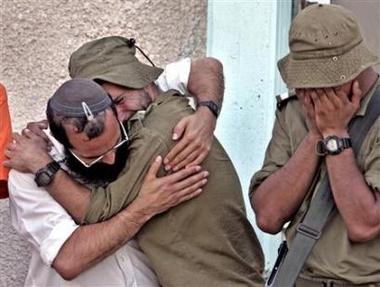
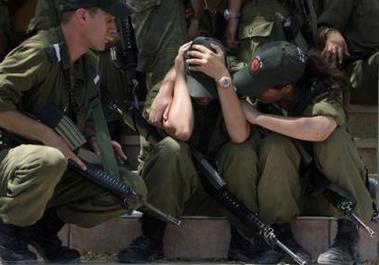
The once-vibrant settlements of Gush Katif are becoming ghost towns before our eyes. Jews are being forced to leave, and their homes destroyed. Yes, this has happened before. This is what we mourn on Tisha B'av.

I always thought of it in an abstract way. I never thought I would see it with my own eyes.

Perhaps once I thought some good would come of it. But I don't believe it anymore. I hear our enemies declare: Jerusalem is next!

On Passover, I too said, "Next year in Jerusalem."

Today is Tisha B'av. Cry for Jerusalem. And cry for Gush Katif as well.

Friday, August 12, 2005

Tisha B'Av

I spent years at Camp Ramah in California. Untold hours roaming the hills of Ojai and living and sharing an incredible experience as part of a Jewish community. It was fabulous and I have many special memories.

And I have many memories regarding Tisha B'Av at camp. But one thing sticks out among all of them. It was a guarantee that the hottest day of summer each year would fall on Tisha B'Av. The day would come and without fail there would be a blue, cloudless sky from which the sun would beat down upon us.

There were a couple of times in which campers burst into flames. They would be walking across the hill and bam! Flames would come shooting right out of their heads. It was not a pleasant sight.

Ok, I am exaggerating, but it was always really hot or as my 4 year-old says really, really, really hot to the moon and the sun.

My campers used to ask if part of the point of the chag was to suffer, it was that hot. But I always managed to find a lot of meaning in it.

One other quick memory to share. When I was a camper we used to have one of the worst meals I can think of to break the fast. It was a tuna casserole, but there was always something foul about it. It never smelled right to me, there was always something not quite right.

So we learned to prepare a post fast meal that we could rely upon. It wasn't incredibly healthy, but it was good. Chips, salsa, chocolate, coke, cookies, licorice and assorted odds and ends.

Sometimes I miss those days.

Monday, August 08, 2005

The J-Blogosphere is Our Community

I spent a few minutes considering what I wanted to write about. There were numerous paths to take, discussions about Rashi's yahrzheit, more about the disengagement, a drash on any number of topics and of course Tisha B'Av.

But the more I think about it the more I want focus on something that I find meaningful and positive. I want to focus on the community that is continuing to develop among the Jewish Blogosphere. I want to celebrate with you the bonds that we are forging among people who we might not ever encounter.

I want to sing about the opportunity to meet and interact with Jews of all backgrounds because I find that to be very special. It is nice to explore and learn with you all. It is so interesting to glimpse pieces of your worlds because some of you live lives that I can only imagine. I don't have any friends who live among the Satmars, the Lubavitch or Chassidus in general.

I can look at Reform, Conservative, MO, and beyond and see people I know. I have been privileged to spend Shabbos with many different groups and it has been fascinating to me. We share so much in common, the roots go back to the same place, but the way in which they branch out provides so many differences.

There are times in which the words from my keyboard in an easy free flowing manner that is simple yet eloquent. I wish that this evening was one of those times because I really do feel strongly about this. However my abba taught me to play the hand that I am dealt and I will continue to speak from my heart, convoluted or not.

What I really want to say is that even in spite of the anguish some of us feel about the disengagement and the uncertainty we feel about this and that there is still much to celebrate. My hope and desire is that in the years to come we are able to use this venue to grow stronger and to continue to learn together.

Please be well and may we all continue on in strength and good health.

-Jack

Thursday, August 04, 2005

The Anguish of Disengagement

I have been following the disengagement process for quite some time and really have been torn up about it. If you are interested here are links to some of my thoughts thus far.

At this juncture I think that I have come to the following conclusions:
  1. I think that Gaza is not worth keeping. It overextends and overtaxes valuable resources and doesn't provide the return that it should to keep it.
  2. A unilateral disengagement may create a huge problem if the terrorists are allowed to claim that it happened as a result of their actions. And on that basis alone it is worth reconsidering because if it encourages more terror it does not serve anyone.
  3. The people that are being forced to leave their homes deserve better than this. They deserve more and there is nothing that can be offered that will adequately compensate this sacrifice.
  4. When it comes time to actually remove people I do not believe that we are going to see a miracle. The IDF will come in and do their job and people are going to be hurt. I pray that we see no serious injuries.
  5. Protesters who influence their children to engage in dangerous activities are acting irresponsibily. It is useful and valuable to teach them to stand up for their beliefs and principles but foolhardy to ask them to risk injury or death.

There is more that can be said, but this is a situation in which I feel as if my words are failing me. I am torn and upset by it and in my head I remember chanting Eicha while looking out on the Old City.
"It was Tisha B'AV and we were in the hills overlooking the Old City. We read Eicha and discussed the burning of the Temple, the sack of Jerusalem and the moment made a huge impact upon me. I could look out on the city and picture the flames, in my mind Jerusalem was burning. I could hear the screams of the women and children, smell the fear and feel the greed of the invaders."
G-d help us all.

(crossposted at Jack's Shack)

Tuesday, August 02, 2005

Define This

What is a Jewphemism?

Friday, July 29, 2005

The VCR didn't make me frum

OK, so I lied. The VCR didn't make me Sabbath-observant. It made it easier for me to avoid desecrating the Sabbath. So it removed a negative, but that doesn't necessarily imply a positive.

So what made me frum? Two words:

Peer Pressure.

What can I say? In some schools, peer pressure makes people smoke. In mine, it made me guilty about being a Sabbath desecrater. My parents sent me to a school where, for eight years, they taught me that Jews were supposed to keep the Sabbath. And even though a good portion of my class did not keep it, or Kashruth, or many other things (toilet paper included), we began to look at ourselves as a bunch of Juvenile Delinquents. The bad boys (and girls) of the school.

As I became more friendly with Orthodox kids, I found myself becoming more ashamed of watching TV, working in the store, and doing other things I wasn't supposed to do on Saturday. In fact I have one memory which I must have suppressed for about 30 years, because it just popped into my head as I was typing this:

I was working at my Dad's store on Lefferts Blvd one Saturday morning, and I must have been standing outside for some reason. Suddenly, I see a bunch of OJ's walking home from shul in their Saturday finest. And one of them is a friend from school, Ari (who lives down the block). I panicked. I tried to pretend that I wasn't working at the store, just visiting the neighborhood. Which was preposterous for many reasons: I didn't live anywhere near there, I wasn't wearing a suit, and most importantly, he knew it was my Dad's store and it had my name across the top of the sign! To his credit, he just wished me a "good Shabbes" and kept walking.

But I began to feel like I was leading a double life, and at some point, maybe when the VCR showed up, I decided to keep Shabbos and other Mitzvot.

The real question you should be asking is why do I stay Orthodox. Now that I am a grown-up and can do what I want. That is much more complex and I don't know if I can give a good answer here. I guess at some point I bought into the program. I've always been somewhat superstitious (with a mother like Rose, it's hard not to be). I've felt that Gd is real and watches me and pays attention to what I do and rewards me when I'm good and punishes me when I'm bad. Whether that's superstition or religion is a matter for debate.

And I looked at the people around me. Those who were Orthodox, and those who weren't. And from what I could see, the Orthodox were happier. Sure they kvetched more, but they had happier, more contented homes. Less divorce, less drugs, more time spent together. Judaism as a religion seemed to work. My friends and cousins who were irreligious intermarried and their kids are not Jewish.

This may be disappointing to some of you who expected a story about a sudden miraculous inspiring event or a flash of light or auditory hallucinations. I don't think my story is terribly unique, though. But my bottom line is that I truly think that this is the way Gd meant for Jews to live.

So what's your story?

Thursday, July 28, 2005

The VCR made me frum

Jack's recent post prompted me to write about something that I've been thinking about lately. He remarked that there are a few things standing in the path of becoming Shomer Shabbos. They are not major things. Some conveniences, some things that just likes to do to relax. He could certainly go without them if he had to (hey it's not like being stuck in the bathroom with no pre-cut toilet paper), but for now he's not ready to give them up.

I had a similar experience about 26 years ago. At that time, my Dad was still working Saturdays, and we weren't strictly kosher, but I was going to Services Saturday morning and many of my friends were Orthodox. Still, I couldn't give up TV. All of my favorite shows, the British Sci-Fi shows, were on Saturday afternoons, and I just couldn't live without them. A visit to my basement at the time would have proven how infatuated I was with them. Model Spaceships, Lego moonbases, etc.

I felt embarrassed when my friends came over Saturday afternoons. I had to get them out of the house before 5pm so I could turn on the tube. I'm ashamed to say there were times when my friends would stay and watch TV with me.

In 1979 we bought a videorecorder. At that time they were close to a thousand dollars, and required a computer engineering degree to program. This one had a remote control, connected with a long wire. Suddenly, everything changed. I was no longer tied to the broadcast schedule. I started taping my shows on Saturday, and going to Mincha instead of watching. It sounds pretty stupid, but this one device removed a major stumbling block from my path. After that, one thing led to another, and pretty soon I was tearing up toilet paper on Friday afternoons.

Looking back now, 26 years later, it's hard to believe that my faith hinged on a piece of hardware. I think we balance things in our minds. The importance of our faith versus the allure of our vices. Initially the vices outweigh the other. Gradually the scales may tip. Whether this means my faith grew or my desires diminished is still unclear to me. All I can say is, once the scales tipped the other way, momentum did the rest for me.

A Guest Posting From My Wife - "Second Overall, First In The Middle"

"Second overall, first in the middle, Mommy," my daughter chants as we braid the challah dough for Shabbos. Since learning this short-cut to remember how to braid a 6-braid challah a few months ago, my daughter and I have been making challah together.

The amazing thing is that my daughter is 2 years old. She'll turn 3 in August. Since I have a 1-year old at home, too, I do take a short cut and use the bread machine to prepare the dough. Otherwise, my kitchen would become more of a disaster than it already is. My daughter loves to help me go to the pantry and get out each of the ingredients. She tells me, "Mommy sugar, yeast, salt and honey." She remembers everything that goes into the dough. Next, she drags the wooden stool across the kitchen floor and climbs on top to see what is going on at counter-height. Then, we carefully dump each of the ingredients into the bread machine. Yes, a little gets dumped on the counter and on the floor, but I try to maintain composure and remember that she is only 2 years old and there is nothing that a wet rag cannot clean up!

She begs me to crack the eggs and measure the flour :)

She pushes the button on the bread machine and we start the dough cycle. After an hour, she hears the beep and says, "Mommy, time to braid!" She runs down to the kitchen and pulls the stool back out. Now, this is the time she LOVES. I give her a piece of dough and she loves to squish and squeeze it with her little hands. "Mommy, it's sticky," she says and I give her a little flour for her hands. She loves this because it adds to the mess.

I divide the dough and she helps me remember how to braid, "Second overall, first in the middle." After I am done with my "big" challah, she lets me braid her "own" challah. It is so wonderful to see her smile when we finish braiding. Now, it is time to cover the challahs to keep them warm while they rise. She tells them, "Night, night...see you soon!"

While she is absorbed with her toys an hour later, I sneak upstairs to put the challah in the oven. A little while later, we have a beautiful Mommy and Daughter challah for Shabbos.

My husband comes home from work erev Shabbos and our little girl helps set the table and get things ready for Shabbos. She even helps place the candles in the candlesticks. When I finally bring the challah board over with the challahs covered for Motzi, everyone is excited to see what is underneath! At last, my husband says "Kiddush", we wash, and then we say Motzi. Ah...with a big smile, he uncovers the challah my daughter and I made.

Her ear to ear grin is priceless. After Motzi, she spends most of the meal drinking grape juice and gnawing on the mini-challah I braided for her.

"Daddy, second overall, first in the middle, me do it myself," she tells my husband. The moments we create now will last us a lifetime.

--
(Cross Posted on A Simple Jew)

Wednesday, July 27, 2005

Shomer Shabbos- Not Yet

I don't know about you but one of the things that I find challenging about life is the pace. There are times in which I feel a little bit like the woman on that treadmill and I tend to think of that as being an unhealthy way to live. Sometimes you need to take a moment to stop and smell the roses.

That is one of the things I find attractive about Shabbos. I like the idea of taking a moment to stop and look around. I like to spend some time thinking about what is going on in my life, in the world and to just be.

However, one of the challenges for me is that there are some activities that I find to be exceptionally relaxing that are verboten on Shabbos.

I can give up shopping. It is not like I do a lot of it. I can get away with not driving and I can give up any number of other items. But in truth I find it very difficult to think about not being able to listen to music.

There are so many moments in which I relax by turning on my stereo and listening to something soft and mellow. It could be Miles Davis, Ray Charles or Beethoven. And the thought of not being able to do this bothers me.

You can call me a computer addict as well. I enjoy my time online and spend quite a bit of it reading and engaging in learning. So it is not like I am engaged in frivolous activities, yet these are things that I am not supposed to be doing.

Some of my FFB and BT friends say that they think that I am just short of finding the derech and that when I do these will not be issues, but I have got to tell you, I don't really believe them.

But maybe they are right, life is a journey and I am enjoying it. I wonder where it will lead.

Monday, July 25, 2005

Color Me Disappointed

This may come across as being obnoxious, but I am a little disappointed in the lack of comments here. Primarily because I was excited about the opportunity to try and exchange thoughts and ideas with a diverse group of people, Jews of different backgrounds and experience.

I just thought that it might be a good place for learning more.

Sunday, July 24, 2005

Haveil Havalim #30

Welcome to the weekly round up of blog posts devoted to Israel and Jewish issues. This is issue 30 and in the grand tradition of your host these are a random collection of interesting posts on various topics.

We are going to roll this out with a refuah Sheleimah to the Shmata Queen's father who just returned from the Mayo Clinic.

Pumping my own writing on the Jewish Connection I asked several question about the Akedah. Also at the Jewish Connection you can see some Toronto Pearl's thoughts on mezuzot.

Mobius is seeing things. To learn what they are go to I'm Seeing Orange. Frummer discusses the disengagement in a post called Heartless.
I shared some thoughts about this as well on my own blog. Check it out at this link. Or see what Akiva has to say. Gil blogged about an interview with R. Yaakov Meidan and his thoughts on leaving Gaza.

A Simple Jew gives simple yet effective instructions on how to prepare for a fast. And along those lines Not Quite Perfect gives us a Mourning Star.

Want to know more about being a Spiegelman just try to move quickly to
me-ander.

Shiloh Musings has a nice post about aliyah here.

The Volokh Conspiracy writes What if the Grateful Dead had been observant Jews who lived in Israel?

DovBear has a criticism he calls The closing of the Jewish mind continues...
It's Almost Supernatural shares his thoughts about
Abraham Rabinovich's book "The Yom Kippur." War. Check it out.

Treppenwitz has a solid Photo Friday where we learn what a Tibetan monk does on a billboard in Israel. Want to know about Mainline Churches Attempt to punish Israel point and click. Krum As a Bagel found some odd things and Odd Beliefs.

Wolfish Musings discusses things he learned and didn't learn in yeshiva.

Miriam talks about Sharon's Condi Rice fantasy and B2 says that London Reminds Him of Jerusalem.

In other news the mayor of London is still an idiot. Yonathan has his own interesting roundup here. Over here at Gilly's blog you can learn more about miliuim.

If you read New York's Funniest Rabbi then you know what he has to say about Pinchas and adolescence zeal. Speaking of zeal Shtreimel's last post had some of that as he shared his experiences at a wedding.

At It Is No Dream you can spend a few minutes reading about missing the home that you once lived in while realizing that Israel really is your new home.

We all have our struggles with various things and one of them is sprituality. Frumpter covers this over here. Over at OceanGuy he has some snippets of the coverage of the Al-Arian terrorism trial.

Meryl has a good post about the new Iraqi Constitution and it is uneven approach to people. Rea about it at The Exception Clause. Chayyei Sarah wants to write about a bunch of things and may yet if her schedule frees up a little. Want to know more, then click here. Over at On The Face Lisa confronts the age old joke of where the river of Denial can be found.
*************************************************************************************************************
That is it for now. Hope that you found some interesting new blogs to read. There is some good stuff in there.

If you'd like to host Haveil Havalim - Vanity of Vanities - The Jewish/Israel blogging carnival - send me an e-mail at dhgerstman at hotmail dot com and he'll set you up.

Shabbos -- The Long & Short of It

I like my Shabbos "shlufs" -- my two to three-hour afternoon naps...the time to catch up on all the sleep that I lost out on when I was at the computer late at night during the week.

Problem is: sometimes I get to nap, other times I don't.

Sometimes it's too busy in our household, with the children having guests, with my own children who have no guests needing to be entertained, with the parents having guests, with our family invited out, with our Shabbos afternoon outings to the nearby park, where the children play baseball or on the playground equipment and the adults catch up on the news of the week.

In our community, which is a bit widespread, we live at the top end, thus making it somewhat of a hike from shul to visit the TorontoPearl family. I grew up with a 25 minute walk to shul, so it's not a big stretch for me, but sometimes my two youngest children feel that they're on a walkathon...without anyone having sponsored them! It's a pleasure for them...and me...when they tote along friends from shul for lunch and for a Shabbos play date. The route home doesn't seem as long in the company of good and cherished friends.

When we adults invite friends for Shabbos lunch, we have to think long and hard over whom to invite: Will they make the walk? Will they want to stay till Shabbos is out, if they find it too long a walk back home?

I'm certainly not always in the entertaining mood (remember, I like those long Shabbos afternoon naps) but when we do host, it's such a nice thing. My husband and I work side by side in the kitchen to prepare the talked-about menu, with me often his sous-chef and he taking the lead. But this joint effort results in a lovely-set table, a delicious menu, and the feeling that "we're in this together!"

Sometimes he gets the compliments directed to him for things I made, sometimes I get the compliments for things made by him. We share the compliments, the spotlight and the company.

Today's company did make the walk even though the adults are plagued by knee joint problems and the like. These were people whom I don't see all that often, but who, when we do host them or if we end up at their Shabbos table, have a wonderful, time together. We are equally blessed that two of our sons are good friends.

Kiddush/Shabbos lunch became an afternoon stay. To hell with my nap, I thought, I'm really enjoying this conversation and the presence of these people. The afternoon stay became Seudat Shlishit, followed by the end of Shabbos. I even jokingly invited the couple and their kids to stay over for breakfast...as they were on such a roll.

But of course, I was being cheeky, as Sunday (it's now already Sunday as I type this) is a fast day.

Good food, friendly and down-to-earth families, hearty laughs, good conversation, lovely zmirot, and children running in and out of the room...help make "this day of rest" what it is: a pleasure.

(cross-posted on Pearlies of Wisdom)

Friday, July 22, 2005

Mezuzah: The Straight and Narrow of It

I grew up in a household that had brass and olivewood mezuzot on its doorframes; some were old-looking, the likes of which you don't see too much anymore, others were more modern. But they were there and they sat at an angle, staring down at us, beckoning us to kiss them, or daring us not to.

Unfortunately, I wasn't always heeding the mezuzah's call for a kiss. But for sure upon traveling, I'd be reminded by my father, "Kiss the mezuzah when you leave the house." Those words were like a mantra, the action became a habit. Kiss the mezuzah before taking a trip; make extra sure to kiss it when you step back over your familiar and welcoming threshhold. Thank G-d that you were able to go in peace, and come home in peace, and be able to kiss the mezuzah once again. That was not said to me, but that was indeed the silent message.

When I married, I lived in an apartment for about a year and then we bought our first home. It was not considered a starter home, and thus was a considerable size with four levels. When the sale went through, one of my earliest thoughts was: "How many mezuzot will we need for this house?" It wasn't so much the mezuzah cover I was worried about, it was the klafs, the parchments, which can be costly once you have a number of mezuzot. That house, we decided, had twenty-one doorposts that would need to be covered, both literally and figuratively. The great debate came with the garage: Do we put one on, do we not? The "not" won out at that time.

It was a great pleasure over the years in that house to raise three children and train them in Yiddishkeit, holding them solidly in our arms as we positioned them close to the mezuzot so they could learn to kiss them. Each year the children grew taller and closer to the mezuzot...in more ways than the obvious.

When we moved homes a couple years ago, we decided to "straighten out our lives" by changing our mezuzot from sitting on an angle to sitting straight and tall. After all, this is the Sefardic minhag, custom, and although my husband was raised very Ashkenazic, he is Sefardic, and as I married him, I too am Sefardic.

These days there is a mezuzah on both our garage doors; these days, my children take great pleasure in being able to reach and touch the home's mezuzot by themselves; these days I look at our many mezuzot and think, "Don't forget to kiss the mezuzah on the way in...or out...from anywhere."

Tuesday, July 19, 2005

The Akedah- All Sorts of Questions

I have been engaging in a discussion outside of the MOT circles about the Akedah over here that brought up a number of questions for me that I have mulled over the years.

1) Old Abe fought with G-d about Sdom and tried to save the city, where is argument here?
2) How can you sacrifice your children?
3) What happened to Yitzhak afterwards?

Now I suppose I can kind of buy into the line that discusses this within a historical context in which it may not have been seen as being completely meshugah to be asked to sacrifice a child, but that is a little tenuous for me.

I have wondered if this experience is part of the reason that Yitzhak was the father he was. Here is what I mean by this and some of this may stem from ignorance of the text, but I don't recall hearing much that makes me think of him as being father of the year material. Clearly his relationship with Yaacov and Esav suffered because of this and one could extrapolate that the lesson of not playing favorites was lost on Yaacov.

In theory if Yitzhak had been more evenhanded there might not have arisen a situation of such acrimony with Joseph and his brothers.

Thoughts, comments, questions?

Saturday, July 16, 2005

Speaking of Ignorance

It makes me crazy to hear/read people explain Judaism from positions of ignorance, especially those who call themselves former Jews. I am speaking of those who claim to have converted to some other religion, now I admit to being more irritated by those who have been sucked in by the evangelicals.

I am not fond of missionaries. I am not a fan of their witnessing and or their targeting of Jews and I am not willing to tiptoe around this for fear of pissing them off. I am entitled to my anger and disappointment in the lack of respect that they demonstrate for others. I cannot buy the excuse that religion dictates that they use religious terror to target others for conversion, but I digress.

The real point of this rant is found in the opening paragraph and here is where it stems from. Judaism offers a rich tapestry of traditions and rituals. There is a seemingless endless amount, so much that it is not uncommon for many people to have at best a very limited understanding of why certain things are done.

It goes beyond simple explanations where we say this is done because we follow the practice of Beit Shammai or Beit Hillel. It is beyond categorizing as being the practice of Chasid or Mitnagdim and it extends beyond terms like Orthodox or Reform.

Within that last paragraph I only fainted touched upon the myriad possibilities of hundreds of interpretations of liturgy and ritual. So it is not surprising that there is room for misunderstanding about what we do and why. But all too often in my experience someone has asked a question about why we keep Kosher/Shabbos or any number of other things only to have their question answered by someone who really doesn't have much of a background or education.

And so often these questions are so poorly answered. It makes me a little sad as well as the aforementioned anger because it just doesn't have to be like that.

I think that one of the challenges we face is that there are so many Jews who are unaffiliated and either uneducated or poorly educated. Just to clarify, I don't think that a lack of affiliation has to equate to a lack of education, but the two often work in conjunction.

And I would argue that one of the reasons for a lack of affiliation/participation is the lack of education and understanding about why we do what we do. This is a key area that needs to be addressed in some way or other.

It is one thing to decide that you do not want to keep Kosher, Shabbos etc when you are educated about them and have a made an educated decision not to observe them.

To continue my rambling rant I find it interesting that some people are so quick to denounce various rituals and practices yet do not know much about them. In particular I am referring to the comments a blogger made on a different blog in which he claims to have been liberated from Judaism by his conversion. The remarks he made about Judaism just made it so clear that he never really understood what he was a part of and I am sorry for that.

It is always possible that someone with a solid Jewish education and background could decide to leave and some have. That would still make me sad, but not in the same way.

End of rant.

Crossposted on Jack's Shack.

Friday, July 15, 2005

Healing Wounds

He sat in the sleek black leather chair, overwhelming it with his size and energy. He had piercing eyes and a long gray beard; he wore black. It was not unusual to see someone dressed in this traditional dress in my parents' home. Usually, they were there to collect charity for orphans in Israel, and my parents had their checkbook out. But those men were small in stature and humble. This man was large and angry.

"I want to ask you," he thundered. "What will become of your Yiddishe Neshama?"

It was a good question. I nodded as I sat down on the sofa.

"I don't know," I said.

He looked and me and I gazed back. He sighed. That was it. He had nothing else. He saw that I was facing an abyss, and I didn't care. I really did not know what would happen to my Jewish soul or if I even had one. But regardless, I was going to marry my fiance, Chris.

Events had followed their course: a difficult childhood; the loss of my uncle; estrangement from family; my brother's disappearance; my struggles with depression and anxiety. My friend from Crown Heights had married and moved to Israel. I had broken off my engagement to my Jewish boyfriend and soon afterwards met someone new, a black-eyed musician who sat up all night with me, drinking beer, smoking pot and discussing the universe and esoteric philosophy. He loved me and I finally felt loved. Nothing else compared to that.

And one guy in a black coat, shouting about my soul, wasn't going to change anything.

Eventually, he left and then I left. It was my last visit -- for many, many years -- to my parents' home. I married a non-Jew. They disowned me.

I did see my mother one more time though. While I was on my honeymoon, staying with my new husband in the Adirondacks, a call came through that my grandfather -- my mother's father -- had died. Chris and I drove the six hours to Brooklyn for the funeral. We found a room to stay in -- I don't remember where or how. While Chris waited for me, I went to hold my mother's hand. She cried on my shoulder as they lowered the casket into the ground. I put a rock on my Zeida's grave. Then I went to my uncle's home to sit for a while. And finally, I walked out of that Flatbush home and out of Jewish life for good.

"What will become of your Yiddishe Neshama?" the man in black had asked.

Indeed. Did I have a yiddishe neshama? Was that what made me bristle when the professor dismissed literary antisemitism as "irrelevant"? Or was that just my liberal sensibilities? But my husband was a liberal too, and he saw nothing wrong with the depiction of the evil Jewish money-lender in The House of Mirth while I, again, was offended. Some people would say I just offend easily.

My husband wanted us to have a chanukiah in the house, wanted us to celebrate some Jewish holidays, but I was adamant. I didn't want any halfway, washed-out Judaism. At least I had been brought up with the real thing. I knew what it was, warts and all. I didn't want some white-washed, liberalized, ecumenical version of Jewishness. No, I was out of the Jewish business. It was over; that's it!

"What will become of your Yiddishe Neshama?"

What did become of my Jewish soul? I think it retreated for a while. It watched, eyebrow raised, as I studied for my Ph.D. and then rejected as sheer nonsense what goes into an English literature Ph.D. It watched as I read various New Age books, gleaning some gems from among the dross. And then it came forward, beaming, as I walked into shul and heard "L'chu nirannina l'hashem."

It was there all along. I didn't kill it by marrying a non-Jew. That may sound shocking and terrible, but I believe it is true. I'm not encouraging intermarriage, but having done it once, I think it is time we stopped treating it like Jewish leprosy.

When my parents disowned me, I was relieved at getting closure on years of conflict. For me, it made my relationship to my parents something external to my life. They had abandoned me, it seemed, and so I would get by without them. When they later reconnected with me, after many years, it was not the same. They were my parents, but they were no longer essential to my life. Some rifts are never bridged completely.

Three weeks from now, I'll be in Israel. My mother is gathering up the cousins to see me -- cousins she forbade me from speaking to for many years. That pain, that rejection, is not forgotten. Does my mother think I'll automatically bond again with these cousins of mine? Maybe she doesn't hope for that, maybe she wants to just have some small acknowledgement of family, even if we cannot heal the wounds. We'll see. I'll let my yiddishe neshama guide me.

Wednesday, July 13, 2005

Bigotry and Education Revisited

In some earlier posts I wrote about the problem of bigotry in our community and asked some questions about the importance of a secular education.

I want to revisit these two thoughts for a brief moment. Within the last couple of weeks I have read/heard/seen some exceptionally obnoxious remarks that cannot be called anything other than racist and bigoted. And one of the things that bothers me the most is that they are coming from our community.

I refer to our community because I am including all Jews, regardless of denomination and or affiliation.

For some reason they think that it is ok to look down their noses at goyim. See, you have to say goyim like you have something foul tasting in your mouth or are in the presence of something putrid.

They think that it is cute and clever to claim not to have the same problems as the goyim. The problem is that this is false, it is a lie. We are all people and we share the same positive/negative traits as others. It is well and good to try and be special and to be Shomer Mitzvot, to try and be a Torah true Jew, but you kill it when you make these horrific remarks about others.

I am confused as to what mitzvah you fulfill when you use your blog to demean and dehumanize others.

And in regard to my comments about education you look even more foolish when the defamatory post you scribbled is riddled with grammatical errors and spelling mistakes. It makes you sound even more ignorant than the stupid comments you make.

Since I am in the mood to continue this rant I'd like to remind you that people who hate Jews hate all of us. They don't give a rat's ass if you are a Satmar Chasid, a MO woman, Reform, Conservative etc. They are happy to hurt any and all of us.

And now for the kumbaya moment of this post. The world becomes a much nicer place when we drop the false pretenses and stop trying to prop ourselves up with the kind of straw man arguments I mentioned before.

Tuesday, July 12, 2005

Tefillat HaDerech (The Traveler's Prayer)

I didn't always say Tefillat HaDerech when I traveled at a young age; perhaps I was in my late teens or early twenties when I began to say it. I don't recall what made me start saying it, but I even remember that sometimes a Kosher airline meal would have it printed and enclosed within the sealed wrappings of the meal.

Usually I traveled with my mother, and she'd pull a card with the prayer out of her wallet, so I'd read it aloud for the two of us and she'd answer "Amen."

In later years, I got my own card that I carried everywhere. It was a brilliant idea really. A cousin, instead of printing place cards with table numbers for his wedding, had Tefillat HaDerech credit-type-like cards printed. The front had the bride/groom's names, date of wedding, my name and table number embossed on it, and the back had Tefillat HaDerech. It is useful, it is practical and it is just the right size for a wallet or shirt pocket.

The truth is that these days I'd feel lost without my Tefillat HaDerech. It is my version of the American Express card: "Never leave home without it." Whether we take Sunday drives out of town, or once-in-a-while flights somewhere, I pull out that little gray card, read it aloud for myself and my husband or family. On my recent trip to California, I knew I had it in my purse -- I'd put it in a "special place" so I'd be sure to find it when I needed it, but wouldn't you know that when I needed it, I couldn't find it. I'd noticed a modern Orthodox man, wearing a crocheted kippah, seated one row over and one seat behind me, so I turned and asked him if he had a Tefillat HaDerech that I could borrow. "In Hebrew or in English?" he asked me. He was certainly equipped, I thought then, and later I knew that I was right as he pulled out some big sefer to learn from. I was relieved when I later found my own prayer right in the special spot I'd claimed for itin my purse, so special, though, that it had gotten temporarily lost!

And on our recent drive to and from Florida, I also was the official reader of the tefillah for my family.

I'd like to think that every tefilla is heard and hopefully answered in the wished-for way. And for those people who might not believe as I do, and wouldn't say the Traveler's Prayer, I want to say, "Think about it this way. You believe it might not help...but it couldn't hurt!!!"

*****

And as we arrived home safe and sound after our long road journey to and from Florida, and I kissed the mezuzah on my way over the front-door threshold, I thought about what my parents have always said. "It's nice to go away...but it's nicer to come home."

I chose to write this post because I can't stop thinking of the recent tragedy that befell the Milwaukee Jewish community, which I learned about on motzei Shabbos, when I started to skim through two weeks of favorite blogs that I'd missed reading. A young mother's life was tragically taken in a car accident when the family vehicle she was in collided with another vehicle. The family was en route to a simcha, a wedding, and to deposit a child and a child's friend at a camp. This mother of ten children lost her life. This woman's husband and their ten children (bli ayin hara) lost a huge chunk of their lives.

And I can't help but think that she, too, recited Tefillat HaDerech en route...

Monday, July 11, 2005

Aliyah- Stuck Between Two Lands

I live a dual life, I am stuck between countries. I am torn by love for home and love for home, or at least the home my head and heart tell me could be.

It has been seven years since I was last In Israel. Seven long years in which so many things in my life have changed I cannot imagine what it was like before.

Ten years ago I returned from Israel determined to make aliyah, or so I thought. The day I came back I sat on my couch and stared out the window of my apartment. I suffered through a lifetime in a day and wondered what I could do to fix things, to make it possible to make aliyah and to find out what life would be like.

It is clear that I never made the move. I investigated it, but perhaps not so thoroughly as I could have. I mulled, considered and davened about it. I wondered and looked for signs. I found many, but they were not clear. Nothing pointed in one direction or another.

As I look back I remember considering a couple of different options. I could go do some learning and see where that took me or I could try and find a regular job. I wasn't sure if I really wanted to go down the path of yeshiva life, couldn't quite decide if that was for me and was concerned that I would regret doing it, so I didn't.

I looked at Intel, Motorola, Office Depot and other American companies that do business in Israel and considered trying that avenue. But I was too young, too green, too inexperienced and I didn't find a way to make it happen.

Many things have happened that make it tougher to try and make the move. There are so many more people to be concerned about, it is a much harder decision and I wonder sometimes if I made a mistake by not pushing harder when it was just me.

But I try not to live in that space because what is done is done and there are so many blessings in my life. Still, in the quiet of the evening I sit and wonder what could have been and perhaps still could be.

Am I willing to make the effort. Am I willing to make the move, to make the necessary sacrifices and can I ask that of my family.

Am I willing to ask my children to one day become chayalim, to place themselves in danger when their abba has not. I am not a 20 something anymore, I am 36 going on 40. They are not going to stick me in some combat unit or any unit of any consequence. I am young, but still too old for that.

And so I come back to that place where I ask what am I willing to do. Is this a dream that will remain a fantasy forever. Or when the children go to college will I make the move then.

I wonder............

Sunday, July 10, 2005

A Community Dying

I belong to a Jewish community that can only be described as dying. The bigger question for those of us who even care is...WHY?

Well, technically, the reasons are obvious. Our membership is down. Income is down. There are fewer and fewer children in the religious and Hebrew schools. The same four people work every event and the same seven people attend. All of this in and of itself spells death for our community.

But, personally, I think there may be bigger and more insidiuous reasons and more than a few center around our rabbi, which then begs the question....did the community kill the rabbi or did the rabbi kill the community?

Our rabbi has been under our employ for about 16 years or so. She came to us about 10 years out of rabbinical school, unmarried and probably more than a little ambitious.

While our community is technically a Reform congregation, we have many members who are Orthodox or Conservative and so our minhag reflects that. Our services are an eclectic blend of all three and I am sure because there really isn't any other choice out here in the boondocks and a good thirty miles from the next larger Jewish community, well, it works, or at least HAS worked, for us.

Now, though, who knows? Does it work anymore? What is the problem? Is it the area's population-retention problem in general or is there a more specific cause?

Since our rabbi first signed her contract with us, she has married and had a child. Her husband does absolutely nothing along the lines of rebbetzin even though he likes to point out that this is his title within the congregation. Generally he sits in the back and makes strange comments to people or tells off color jokes to the young women.

The boy is another ball of wax altogether. He is the rabbi's son after all. He rules the roost and acts as a Pied Piper in leading all of the other children astray. The adults generally click their tongues and shake their heads as his behaviour increasingly becomes worse and worse. But nothing can be done because neither the rabbi nor her husband WANT anything to be done.

The child tortures children who are less able or who have handicaps and the mother makes excuses, blaming the less abled child for making HER child uncomfortable around them. When the toilets exploded, nothing was said, although tzedakkah was offered on behalf of this boy.

And I will concede that he is bright and capable and able. I do take issue though that from among ALL the children he is the MOST abled.

When he is running wild through the oneg, kicking people and screaming, blindsiding his father to the floor and then running off to throw books at the EXIT lights until they fall down there ARE actually people who will tell him to stop....as his mother looks on wanly from the sidelines, forever his best friend and champion since it will be true that SHE never corrected him.

But I suppose he has a good example for his behaviour as the rabbi, herself, is known to snark when someone makes a mistake in front of her or to throw a temper when her contract comes due.

Two months ago as her contract was being renegotiated, her son proudly stopped playing with the posse of lemmings who blindly follow and obey him, and looked at a congregant and told them, "My mom is going to quit this place and move us to the BIG city and then this place will collapse and die!"

Then he ran off.

Sadly, this may very well be true since most of the members don't believe we can replace her. That no rabbi would come to this one horse town for the one horse salary we are able to pay.

Community members who tell me they'd like to come to services then tell me that the rabbi is a very "coarse" woman when I tell them to call her to make arrangements to attend.

What do new members think?

I know what I thought!

Despite being her student, when I attended services, I felt alone and embarassed because never once did she introduce me to another person. During class she spent the one or two hours talking about herself and then would cancel months worth of lessons afterward. Now, granted, she did have huge commitments that year that prevented regular classes but I always felt she finally took me to the mikveh more for my potential dues than for my definite readiness.

(Fortunately for me, I had started taking classes in the next larger community and I was assuredly READY despite her lack of attention although it does make me wonder - how ready was everyone else she converted, especially those we never see again?)

I have to wonder - did her enthusiasm due as a result of our apathy? Did her commitment and ambition become casualties of a community that was withering on the vine? Did she pour her energy and her soul into us only to have them sucked out of her until she was completely dry and just couldn't care anymore? Or did her lack of concern suck our own enthusiasm dry? When she shot down ideas to revitalize ourselves, did that steal our own enthusiasm? Was our energy sucked out by having to support a family at the helm who clearly didn't care or respect US????

It all comes back to the sad fact that our community is dying - whatever the cause, it has put us on life support.

And to solve this problem, I really feel we have to conclude WHAT exactly was the cause?

I may be wrong and G-d knows I have been before. Maybe more people love this rabbi and her family than I am giving credit. Maybe the major cause isn't the turmoil within the walls of the synagogue but really, truly a great exodus of the area's population which, naturally, would include any available Jews who would normally be members. Maybe it's just exactly what the URJ says it is and that is a declining interest in affiliation with ANY movement...a natural by-product of the in-fighting between the branches of Judaism today. I admit that that would probably, in the end, be PART of my own reason for choosing to unaffiliate.

But whatever it is, clearly, there are issues which cannot be painted over. We cannot pretend they aren't there and don't exist.

A lot of people say, "Wait for the boy's bar mitzvah" and think that she will leave after that...implying that while there IS a problem, it's only temporary. Others feel that an influx of new members and hence, an influx of new money will make everything all better. New ideas, new blood....THAT will save this congregation!

But will it really? Or will it simply band-aid over what the real disease is - what is really killing us from the inside out.

I can't help but think that until the REAL problem is discovered, thoughtfully resolved and action taken, nothing we do can save this community.

And although this is an issue faced by the entire Jewish community as a whole, for our little corner of the world, it really is very, very sad.

Wednesday, July 06, 2005

Thoughts On My Yeshiva Past

Another Guest Posting by Lyss from No_Blog

I was never the most popular girl in high school. I was pretty, but definitely spent some of those years going through an awkward stage. It didn't help that my cousin went to a nearby boys yeshiva where he played on sports teams and was a total chick magnet. Girls used to come up to me in the hallway and ask "are you John Doe's cousin? He's so hot!". I never really knew how to respond appropriately to that. Should I have said "thanks" like I'm taking the credit for him being hot? I wasn't really going to agree with them, I mean, he's my
cousin. Ick! This is not Kentucky.

Anyway, I've been thinking back to high school lately ( probably from all the free time on my hands due to my
unemployment). Like I was saying, I was not really popular. Not sure if I wanted to be. A lot of the popular kids seemed* kind of shallow. Funny, considering it was a yeshiva, where one is supposed to learn about the value of spirituality and how it can separate us from the amoral and secular world. Sure they were observant. But when someone who is usually up on their moral high horse asks to cheat off you on the upcoming social studies test I wondered if they realized the hypocrisy of their own actions?

I had my friends whom I loved dearly. Too bad we don't really speak anymore. I guess we live in different worlds. I had three best female friends. When we graduated I went off to
Ithaca and the three of them attended Rutgers together. We spoke occasionally and saw each other on breaks, but as time wore on we lost touch. I'd hear snippets of news about them through my family (the northern NJ Jewish grapevine is amazing in its reach sometimes). The last time I saw two of them was when they came to see me when was sitting Shiva for my father. A nice gesture. I hoped that we would be more in touch after that but it hasn't worked out that way. I miss them. They all stayed in the NY metro area while I went upstate and then off to New England. I sometimes think that since my parents were not Othrodox and I didn't grow up in the Teaneck/Englewood/Fair Lawn triangle it was easier for me to get out, so to speak. Despite spending something like 60% of my time in high school in Teaneck at my aunt and uncle's house I was a visitor to their world, living on the fringes. I didn't come from Moriah or Yavneh like the majority of my classmates did (the rest of us were a mix of RGHDS (where I had gone), Solomon Schechter of North Jersey, ASHAR, public school, Kushner, YNJ, and SAR). I was an outsider from day one simply because I was not as observant as the bulk of my classmates, I pronounced my my Hebrew words correctly (Bereshit, not Bereshis), and I was not in the Kollel level classes (which meant staying extra hours after school on Thursdays, not appealing to someone who lived 45 minutes away with the awful NJ traffic).

Though I didn't love it at the time I suppose that being an outsider taught me how to survive when you're the one labeled
different. It gave me strength and taught me that being who I am is more important than being who someone else wants me to be. My friend, L, put it this way in an email: "You're not afraid to let people know who you are off the bat and you don't compromise who you are for whose company you're in".

*I am not saying that all the popular kids were X, Y, or Z...just writing about the way things seemed to me.

Bigotry In Our Community

I haven't the time or the energy right now to give this post the attention it deserves, but I cannot not say something.

A short time ago there was a Gay rights parade in Yerushalayim. During the parade a very sick individual stabbed three people.

In the time that has elapsed since that event I have seen a number of posts around the blogosphere in which people have tried to justify and or minimize the stabbing.

This is wrong. It is hurtful, hateful and full of the worst that we have to offer.

Each day I see things that I disagree with. I see people engaged in behavior that I think is wrong, but I don't go and try to murder those I disagree with. The overwhelming majority of people do not engage in violence based upon disagreements with others.

This shameful behavior must not be condoned or tolerated. It is not a matter of saying that you think that homosexual behavior is a chillul Hashem. It is not a matter of saying that you think that this is so terrible your children should not be exposed to it.

There are many ways of protesting such actions and activities that do not involve sick and degrading behavior like stabbing others. When we make excuses for people who do this we demean ourselves.

Tuesday, July 05, 2005

It Made Me Sad

A number of years ago I was out and about the fine metropolitan city I currently reside in, when I suddenly felt an overwhelming need to daven. I can't tell you why or what, just that I felt the need to commune with Hashem, but not alone.

As it was a summer day and the temperature was well over a 100 I was dressed in shorts and a t-shirt. I was momentarily concerned about going to shul dressed that way, but two things stopped me from running home to change.

First, there wasn't time to change and still make the minyan and more importantly to me it is nobody elses business how I dress. If I am coming to shul in clothes that cover my body are not unnecessarily provocative, do not have obnoxious slogans or whathaveyou, then it is between me and Hashem.

When I arrived at shul I quickly hurried to make the minyan when I was accosted at the door by someone who had decided to serve as the gatekeeper of who should or should not be allowed to enter.

He blocked my path and began to chastise me for not being respectful, for showing up in this fashion in his eyes was a complete affront to all of the members and to G-d.

I don't do well with being told what to do by anyone so I politely asked him to step by and when he wouldn't move asked the others in the minyan if there was anyone in there who could cite chapter and verse as to why their tefilah was more important and or more likely to be heard than my own.

It made me sad to have this fight, but darn it, I hate people who think that fancy trappings, gold wrapping paper, silver bells etc make a difference. Cliche or not, it is what is inside that matters.

None of these people knew whether I was rich or poor. I could have been wearing the finest clothes I owned, it really shouldn't matter.

A suit and tie are worthless if there is no kavanah in your davening.

A Quote For This Group


The more Jews with different views come together and speak about how to do what G-d wants, the more G-d's simple unity is revealed in the world.

(Reb Noson of Breslov)